All posts by latinbusinessdata

Marriott CEO to join Obama in Cuba

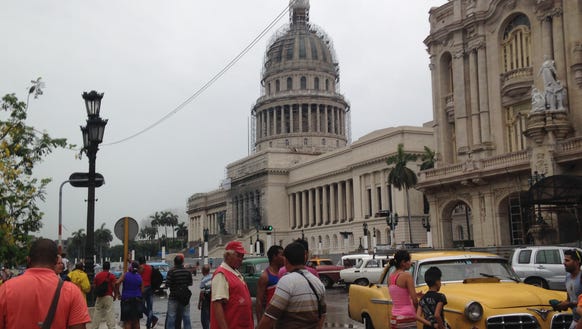
The bustling streets of Havana are filled with classic buildings and classic cars. (Photo: USA TODAY/Nancy Trejos)

The CEO of Marriott International, Arne Sorenson, will accompany U.S. President Barack Obama on his official trip to Cuba on March 20. “We are optimistic that we are going to get a green light soon from the US government to have hotels under the Marriott flag in Cuba,” said Marriott spokesman Thomas Mader. Sorensen also serves as vice chair in President Obama’s Export Council.

Read the full article on USA Today.

Mexico’s Femsa debuts in euro bonds

Fomento Economico Mexicano sold euro-denominated debt for the first time on Monday, joining a wave of Mexican borrowers tapping the market as the European Central Bank starts buying investment-grade company debt. emsa, which owns Latin America’s largest convenience-store chain as well as a stake in Heineken NV, sold 1 billion euros ($1.1 billion) in seven-year bonds.

Read the full article on Bloomberg.

The 100 Most Powerful People in Latin America 2016

From left: Carlos Slim Helú (picture ITU Pictures/Flickr); Miguel Galuccio, CEO YPF; Eduardo Belmont, Owner Belcorp.

Latin Trade presents the 2016 list of Latin America’s 100 Most Powerful Business people who operate in or with the region. This year, the list includes many new names from across the region who have excelled in their leadership to steer their businesses through the economic headwinds that are hitting Latin America.

Read the full article on Latin Trade.

Brazil’s Rousseff refuses to resign

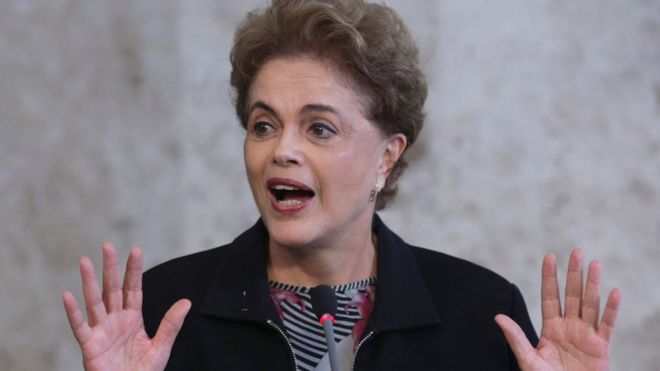
Dilma Rousseff said the opposition had sparked a crisis which was hurting the economy. Credit: AP

Brazilian President Dilma Rousseff has insisted she will not resign over her alleged mishandling of the economy after moves to impeach her. She accused her opponents of causing a political crisis which she said had damaged the economy. Rousseff also defended her predecessor, Luiz Inacio Lula da Silva, over money-laundering allegations.

Read the full article on the BBC.

Emirates puts Latin American hub on hold

Emirates, the world’s biggest long-haul airline, put its plan to establish a hub in Panama connecting cities across Latin America with Asia on hold because government accords permitting cooperation with a key local carrier took too long to put in place.

Dubai-based Emirates has secured approvals from only three or four of the 13 countries from which it needs backing for a wide-ranging code-share deal with Panama City-based Copa Airlines SA, its president, Tim Clark, said at the ITB travel fair in Berlin.

Read the full article on Bloomberg.

Bello: The return of an old enemy

An inflation test for Latin America’s central banks
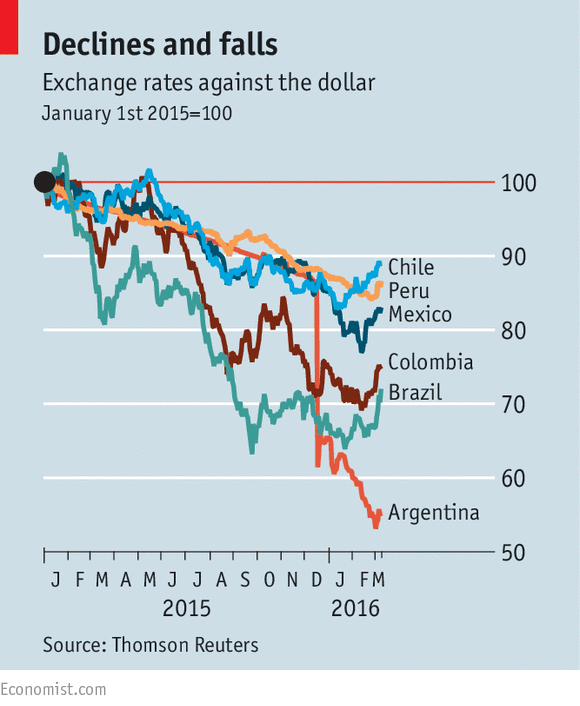
OLDER Latin Americans still have vivid memories of hyperinflation. Bello recalls changing money in dark doorways in the mid-1980s in Bolivia and being handed a truncheon of greasy banknotes secured by rubber bands. Peru went through a futile currency reform in which the sol lost three zeros and was briefly renamed the inti, which promptly racked up more zeroes.

Hyperinflation destroys businesses, undermines political systems and hits the poor especially hard. Latin America should have learned this painful lesson. So when in Caracas recently Bello was given a large shoebox packed tightly with banknotes in return for a few hundred dollars, he received it with an eerie sense of déjà vu and dismay. Official statistics put the rise in the consumer-price index in Venezuela last year at 181%, the world’s highest; the IMF forecasts 720% this year. Venezuela is extreme in its economic mismanagement. But while the rest of the world worries about deflation, across Latin America prices are rising. In Argentina, inflation is forecast to spike from 27% to 33% at an annual rate; in Brazil it stands at around 10.5%; in Uruguay, it is only one point lower, and in Colombia it has climbed to 7.6%. In Chile, Peru and Mexico it has also ticked up.

Read the full article on The Economist.
Brazil’s sugar cane growers get boost from anti-coal push

Global efforts to curb the use of coal-fired power plants may provide a lifeline to Brazil’s embattled sugar cane industry. That’s the bet of companies including Cosan SA Industria e Comercio, co-owner of the world’s largest sugar-cane processor, which formed a $130 million joint venture for making sugar cane-based biomass pellets that can be burned to produce electricity.

Read the full article on Bloomberg.

Argentina’s economy contracted 3.5 percent in fourth-quarter 2015

Argentina’s economy was “clearly in recession” toward the end of last year with gross domestic product contracting 3.5 percent in the fourth quarter, the president’s Cabinet chief Marcos Pena said. But the country’s statistics are cloudy as new President Mauricio Macri reforms the government’s data agency, following complaints about inaccurate numbers published by the previous administration.

Read the full article on Reuters.

Guatemala: Profit Powers Clean Water for Poor

How a water filter company turns a profit while helping Central America’s poor.

In the last school cycle, Ecofiltro reached 822 rural schools and provided clean water to 173,000 rural school children. (Photo: Ecofiltro)

Like many social enterprises, Ecofiltro started out wanting to help the rural poor in Guatemala and elsewhere in Central America get access to clean water without much thought to making money. The company makes a water filtration device that families could use to purify their water instead of having to boil it. But CEO Philip Wilson soon realized that changing the entity into a for-profit company actually helped him realize his social goals. In part, he decided not to look at the rural poor as objects of pity for whom help is limited by the extent of donations – the typical template of the area’s NGOs and foundations – but rather as potential clients of a financially sustainable business. Ecofiltro’s strategy was to start selling to the relatively better off urban residents and using profits from this market to subsidize an installment payment plan for the rural poor. Ecofiltro is now profitable and expanding in the region.

Read the full article on LatinVex.

Cuba says Obama ‘welcome’ but shouldn’t expect much change

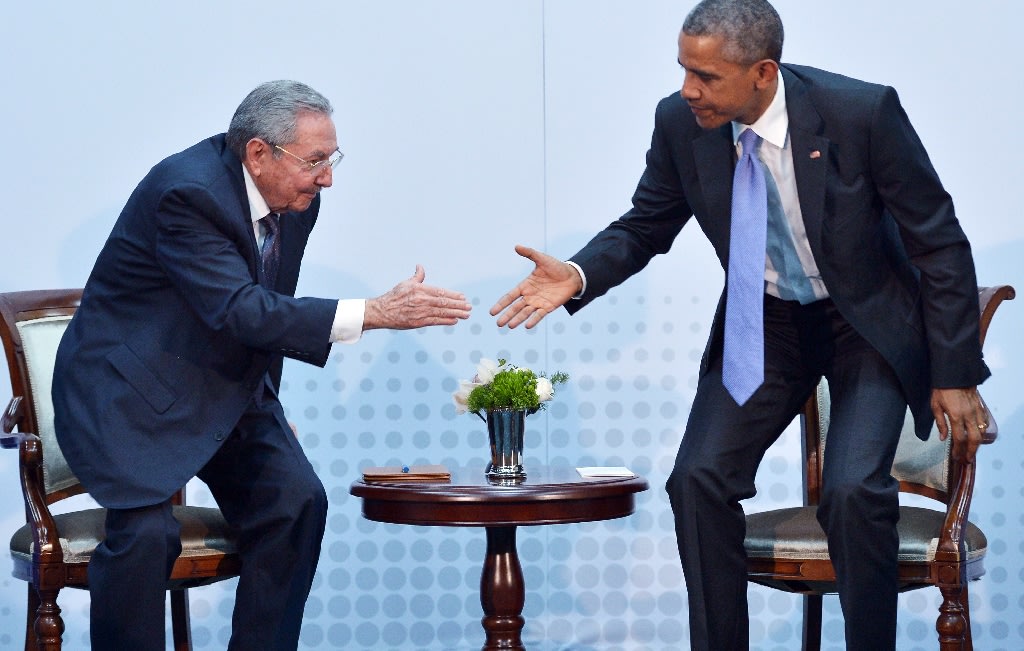
US President Barack Obama (R) and Cuba’s President Raul Castro reach out to shake hands during a meeting on the sidelines of the Summit of the Americas on April 11, 2015 in Panama City. (AFP Photo/Mandel Ngan)

Cuba said it would welcome President Barack Obama to Havana later this month, but the Communist government had no intention of changing its policies in exchange for normal relations with the United States.

In a long editorial on Wednesday in Communist Party newspaper Granma and other official media, Cuba demanded Washington cease meddling in its internal affairs and said Obama could do more to change U.S. policy.

Read the full article on Yahoo News.